Our estate
Our estate is located in Hermonville, just a few kilometers north of Reims, where we cultivate the vine on carefully selected lieux-dits. Between history, distinctive terroirs, and the dedication of each generation, our vineyard tells a human and viticultural story where every plot has an identity, and every wine, a true origin.
The history
The vine has been present in Hermonville since the 12th century, and it is on this land steeped in history that our family has been cultivating it. We are now the fourth generation to carry the estate forward.
The story begins in 1919 with our great-grandfather Alfred, who founded the estate, installed his own press, and sold his wines to négociants in Reims.
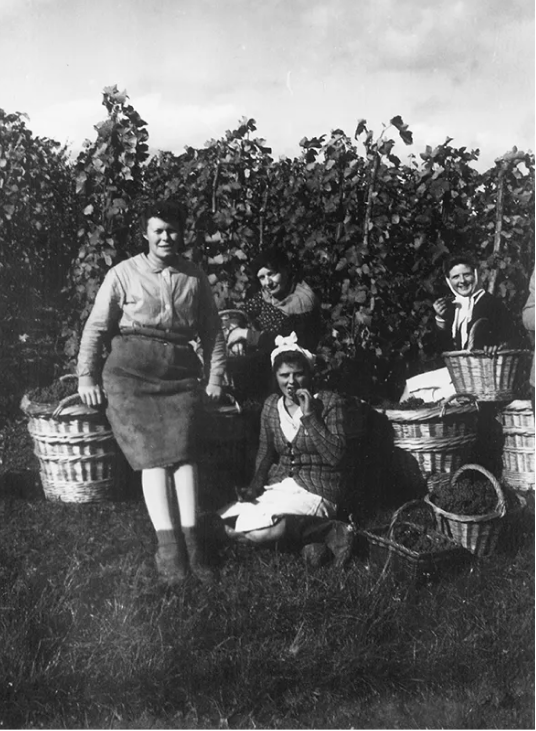
Over the years, the estate grew thanks to the hard work of our grandparents, Henri and Madeleine — as shown in this photo of Madeleine Minière taken in 1956 — and then through the continued dedication of our parents, Gérard and Josette.
Soil. Wine. Time.
A vision
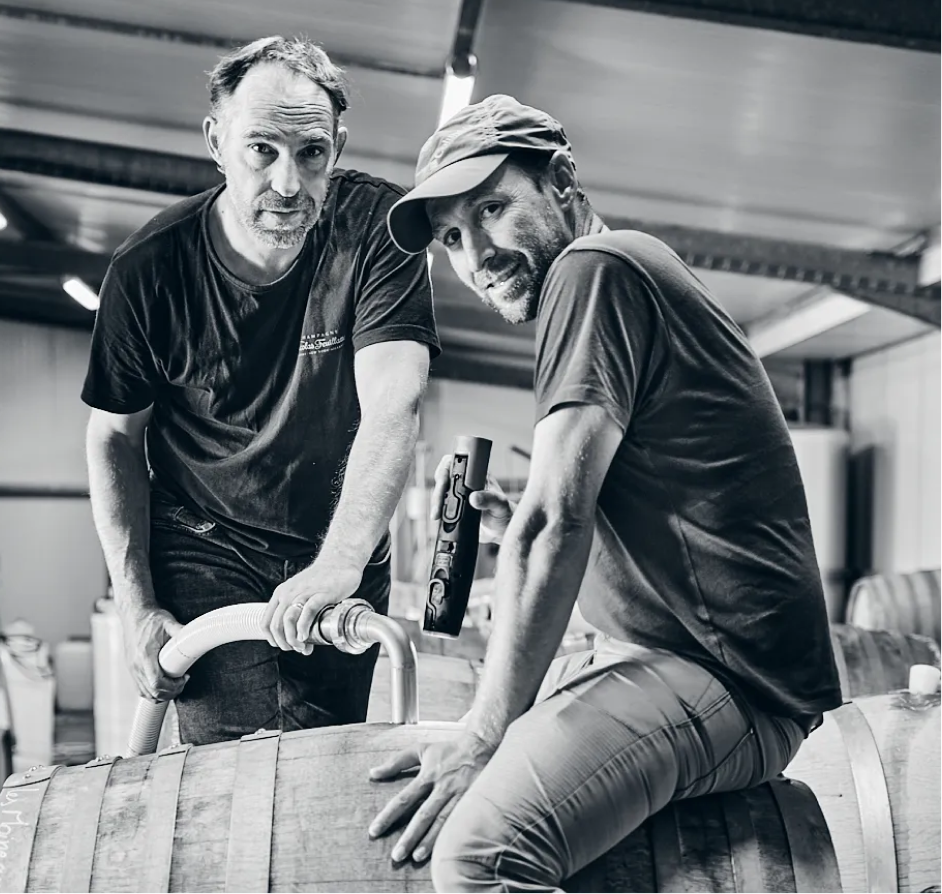
After completing studies in oenology and gaining hands-on experience in the field, we took over the family legacy in 2005. Respectful of the work accomplished before us and eager to contribute our own chapter, we chose to create our own cuvées—guided by our credo: respect for the vine and carefully tailored, precise vinifications.
We strive to preserve the identity of our terroir by carefully cultivating our old vines, practicing massal selection, and adopting environmentally respectful methods.
We have chosen to vinify in oak barrels not as a mere technique, but as an essential tool for expressing the wine’s character, inseparable from our style. This process requires time and attention, allowing each cuvée to fully reveal its personality.
The vineyard
Spanning nearly 8 hectares, our vineyard is mainly located in Hermonville, on a beautiful hillside facing south-southeast, enjoying ideal sun exposure.
The soils are loam-sandy at the top of the slopes and loam-clay-sandy at the bottom. These well-drained, mineral-rich soils encourage the roots to grow deep, nourishing the vine’s sap with essential minerals.
We cultivate about 2 hectares of Chardonnay, 1.5 hectares of Pinot Noir, and the remainder in Pinot Meunier. Some of our oldest plots are still planted with “francs de pied” vines that is, ungrafted vines just as they were before the phylloxera crisis, an insect plague that devastated nearly all European vineyards in the late 19th century.
These vines produce grapes with naturally low yields, but they offer a true and distinctive expression of both the grape variety and the terroir, which we have brought together in a unique cuvée.
Plots and lieux-dits
All the plots selected for the creation of our cuvées are located in Hermonville, on carefully chosen lieux-dits. A lieu-dit refers to a group of precisely defined parcels, each recognized for its unique identity a singular combination of soil, subsoil, exposure, and microclimate.
Our vines range in age from 2 to 78 years, with an average age of 50 years.
Many of our oldest parcels come from massal selections carried out until the 1980s on the estate and in Champagne nurseries. These grafts were selected in autumn for their agronomic quality, then either grafted or planted directly in the nursery. Introduced in the 1970s, clonal selection brought standardization to vineyards, whereas massal selection favored genetic diversity and the unique expression of each vine. We continue to use massal selection to replace missing vines, ensuring the preservation of our old vineyards true witnesses of our terroir and the faithful transmission of their characteristics.
The layering technique (marcottage) was also used and is still occasionally practiced to replace dead vines. The absence of Phylloxera in our soils is a major advantage, allowing for a respectful, low-intervention approach that results in high-quality grapes.
Our first single-vineyard cuvée, Les Voirmissa, was born in 2013. Produced in limited quantities between 800 and 2,500 bottles each cuvée reflects the singularity of its micro-terroir and carries the natural signature of its origin.